The Art of the Stolen Map: How Great Worldbuilders Mine Reality to Build the Impossible
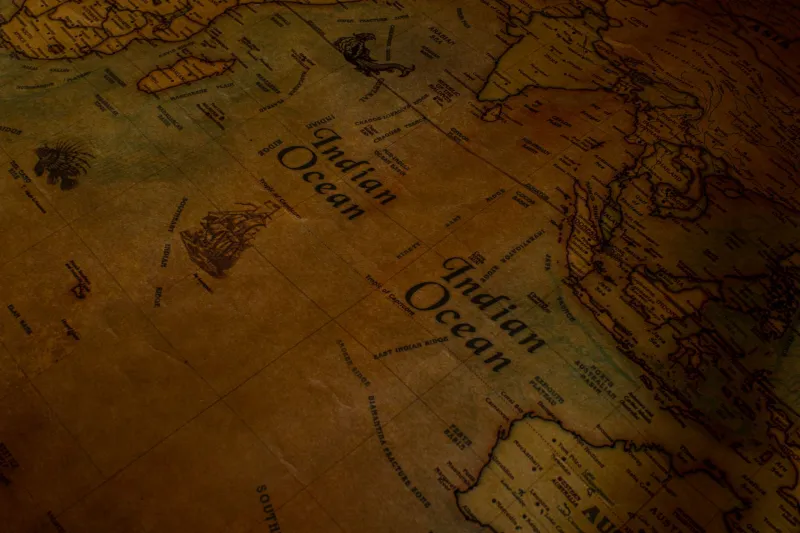
Ask someone what makes a fictional world feel real, and they'll probably say something about consistency, or internal logic, or rich detail. All of that is true. But there's a more fundamental answer hiding underneath those answers: the best fictional worlds feel real because they are real, at least partially. They're built from pieces of actual history, actual geography, actual human behavior — just rearranged, renamed, and dressed up in enough imagination that you don't immediately recognize the source material.
This is the craft that rarely gets talked about directly. Worldbuilding guides love to discuss magic systems and political structures and the economics of fictional kingdoms. But the first question — where does the raw material actually come from? — often gets skipped over, as if the answer is just "your imagination." That's not quite right. Imagination is the workshop. Reality is the lumber yard.
The Map Beneath the Map
Tolkien is the obvious starting point, because almost nothing about his process was subtle once you know where to look. Middle-earth's geography mirrors Northern Europe with the serial numbers filed off. The Shire is the English countryside as Tolkien remembered it from his Worcestershire childhood. The Rohirrim speak a language derived from Old English. Mordor borrows its industrial hellscape from the factories Tolkien watched consume the English Midlands during his lifetime.
None of this diminishes the achievement. If anything, it explains why Middle-earth has the texture it does. Tolkien wasn't decorating a blank canvas — he was transforming something he already understood deeply into something mythological. The familiarity is the point. You feel like you've been to the Shire because, in some emotional sense, you have.
Ursula K. Le Guin worked similarly, though her source materials ran through anthropology and sociology rather than mythology. The societies of The Left Hand of Darkness and the Ekumen books are clearly informed by real cultures — their kinship structures, spiritual practices, and political formations all have analogs in actual human civilization. Le Guin wasn't inventing alien societies wholesale. She was asking: what if this real human pattern got pushed in this particular direction?
History as a Plot Generator
One of the most reliable tricks in worldbuilding is treating history like a plot library. Real events are stranger, more dramatic, and more structurally satisfying than most invented ones, because they actually happened — which means they contain the kind of messy, unresolved complexity that makes stories feel true.
George R.R. Martin has been open about drawing on the Wars of the Roses for the political framework of Westeros. The parallels aren't exact, but they're unmistakable: two rival dynasties, a disputed succession, shifting noble alliances, and a war that drags on long enough to exhaust everyone involved. The genius isn't the borrowing — it's that Martin understood what made the Wars of the Roses narratively compelling and extracted that quality rather than the surface details.
Similarly, Brandon Sanderson has talked about drawing on historical economics and logistics when designing his magic systems. The way Stormlight's fabrials function as a kind of industrial technology mirrors the early stages of real-world industrialization. The social tensions that creates — class disruption, labor displacement, the destabilization of old power structures — are borrowed wholesale from actual history, which is why they resonate.
Geography Does the Storytelling For You
Physical landscape is one of the most underrated elements a worldbuilder can steal from reality. Real geography isn't just backdrop — it shapes culture, limits political expansion, determines trade routes, and creates the conditions for conflict. When worldbuilders understand this, their invented landscapes start generating story automatically.
The Silk Road echoes through dozens of fantasy worlds as a spine of commerce, cultural exchange, and dangerous travel. The political dynamics of islands versus mainland empires — which any student of Greek or Japanese history will recognize immediately — show up constantly in fantasy settings, because they work. They create inherent tension and opportunity that writers can exploit without having to manufacture it artificially.
N.K. Jemisin's Broken Earth trilogy uses a geological framework — plate tectonics, volcanic activity, the concept of orogeny — as the literal foundation of its world's physics and its social structure. The oppression of the orogenes isn't just a metaphor for race and power in America (though it is that). It's also grounded in the real logic of how societies respond to forces they can't control and don't understand. The science makes the metaphor feel earned.
The Art of the Disguise
The skill isn't in the borrowing. Everyone borrows. The skill is in the transformation — taking something real and making it feel like it couldn't have come from anywhere but the story you're telling.
The best worldbuilders tend to combine sources in ways that prevent direct recognition. A political system drawn from the Byzantine Empire, a religious structure inspired by Zoroastrianism, a geography that mirrors the Pacific Northwest — assembled together, these create something that feels entirely new even though every individual piece has a real-world origin. The combination is the invention.
There's also the question of what to borrow. History and geography are obvious sources, but some of the most effective worldbuilding borrows from science, economics, linguistics, and psychology. The way a fictional society handles grief, or resolves disputes, or structures childhood — these details come from somewhere, and the somewhere is usually the real world observed carefully.
Building With Open Eyes
For anyone trying to build a world of their own, the practical takeaway is simple: read widely and pay attention to the wrong things. History books are full of world-building material hiding in plain sight. So are anthropology papers, geology documentaries, economic histories, and accounts of how real communities survive disasters.
The fictional worlds that last — the ones that feel like places rather than settings — are almost always built by people who found the real world endlessly interesting and couldn't stop themselves from smuggling pieces of it into their imagination.
That's not a limitation. That's the whole method.