Nobody in That World Has a Tuesday: How Fictional Calendars Quietly Do the Heavy Lifting
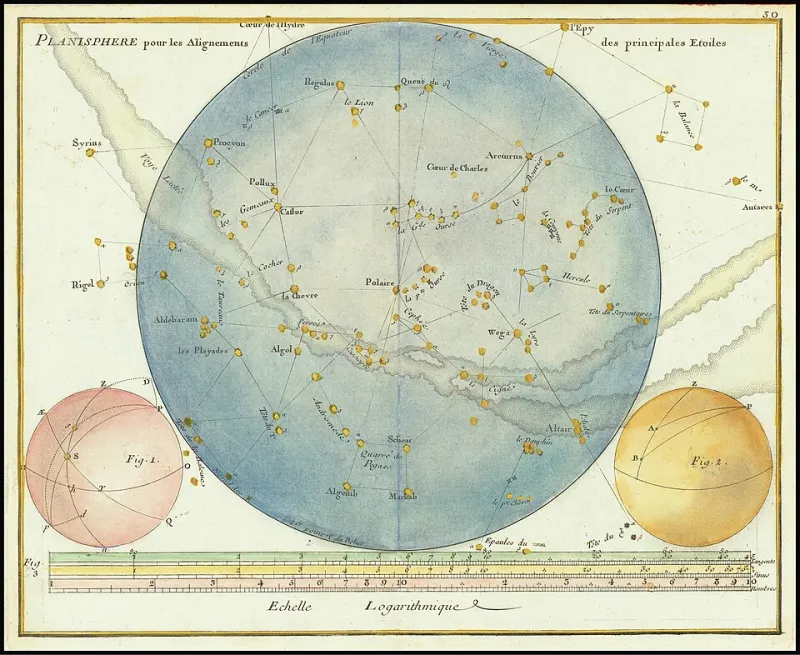
Photo: John Flamsteed, Public domain, via Wikimedia Commons
Somewhere in your notes for your fictional world, there's probably a line that says something like 'the harvest festival' or 'the long winter.' Good. Now the harder question: harvest according to what? Festival on the calendar of whom?
Timekeeping is the worldbuilding detail everyone forgets and everyone feels. Your readers may never learn the name of your world's third month. But they will absolutely notice when characters move through a world where time has no shape at all — where seasons arrive on demand, holidays appear when the plot needs one, and nobody ever seems to be late for anything.
A Calendar Is a Belief System With Numbers
Start with the simple truth: no culture on Earth invented a calendar just to track days. We built them around what mattered. Planting. Flooding. Gods. Emperors. The calendar is a mirror, and the moment you invent one, you've told your reader everything.
A world with thirteen moons and a moon-priesthood for each one is a world where religion runs the government. A world where the year is measured by a starship's orbit is a world where the voyage itself became sacred. A world with no shared calendar at all — where every village counts time differently — is a world that has never been politically united, and probably never will be.
That's the trick: you don't need to explain any of this. Just show a character swearing 'by the ninth moon' and the reader does the rest of the archaeology themselves.
Holidays Are Free Exposition
If you're going to steal one technique from this article, steal this one: invent a holiday and put your characters in the middle of it.
A well-designed fictional festival does more worldbuilding per word than almost any other device. Who's celebrating? Who's not allowed to celebrate? What food appears? What debts are traditionally forgiven, what grudges traditionally reopened? Is it a solemn fast or a civic blowout? Each answer quietly maps the culture — its class lines, its history, its guilt, its joy.
There's a reason so many beloved stories stage their biggest moments at festivals. Everyone's gathered, the rules are suspended, and the reader is already leaning in. A holiday is a plot delivery system wearing a party hat.
When Time Itself Misbehaves
Now push it further. What happens when time doesn't work the way it does in Ohio?
Science fiction has had a field day with this. Ships that jump between stars and arrive before they left. Colonists whose relatives aged decades during a two-year round trip. Cryo-sleep that turns a commute into a time machine. In these stories, the calendar isn't background decoration — it's the antagonist, or the tragedy, or both. Every 'month' lost to relativistic travel is a birthday missed, a child grown, a goodbye that came too late.
Fantasy plays the same game with different dice. A winter that lasts for years isn't just weather — it's a full-scale economic and spiritual catastrophe, and the story knows it. A world where certain nights are 'uncounted,' or where time flows differently in the deep woods, turns the calendar into a border: cross it, and come back to find everything changed.
The common thread: whenever a world bends time, the emotional payload comes from the calendar we take for granted. Missed birthdays only hurt because we know what a birthday is.
The Practical Bits (Because Someone Will Ask)
A few field notes before you draft your own almanac:
Don't overbuild. You need the shape of the year and two or three named dates. Nobody needs your full leap-year algorithm.
Let characters complain about time. 'The taxes are due at the turning' or 'we'll reach the pass before first thaw' teaches the calendar while sounding like a person talking.
Name days after things that matter. Your week named for seven dead kings says something different than a week named for seven winds.
Break time on purpose, not by accident. If your world has two moons but one lunar month, a reader will eventually do that math. Make the weirdness a feature.
The Clock Behind the Story
Here's the quiet genius of it all: a fictional calendar gives your world a heartbeat. Deadlines, seasons, anniversaries, the countdown to the eclipse — these are the rhythms that make a plot feel inevitable instead of arbitrary.
And on a deeper level, inventing time is an act of empathy. You're imagining not just what your people believe, but when they believe it — what they celebrate, what they dread, what they mark on the wall.
So go ahead. Give your world a Tuesday. Or better yet, give it six days and a rest day nobody's allowed to name. Your readers won't thank you directly.
They'll just feel, without knowing why, that the place is real — because real places keep time.