Leave Something in the Dark: Why the Best Fictional Worlds Know What Not to Show You
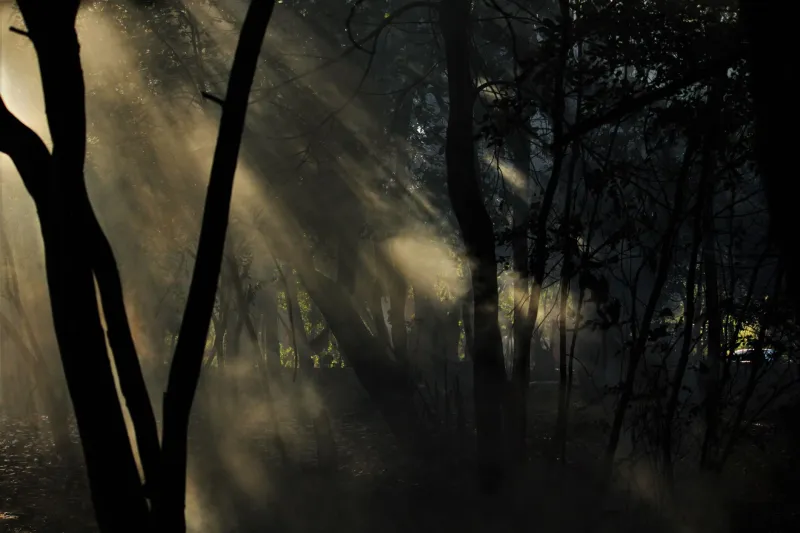
There's a particular kind of frustration that hits when a fictional world you love gets over-explained. You know the feeling — a prequel drops, or an author publishes a companion encyclopedia, and suddenly the thing that felt enormous and mysterious starts to feel... small. Manageable. Ordinary. The magic doesn't disappear all at once, but it dims, like someone turned on the fluorescent lights in the middle of a candlelit dinner.
This is the central tension every worldbuilder eventually runs into: the more you know about your world, the more you want to share. And the more you share, the more you risk dismantling the very thing that made readers fall in love in the first place.
Let's talk about why that happens — and how the smartest builders of imaginary worlds have always known that mystery isn't a gap to be filled. It's a feature.
The Space Between the Page and the Mind
When a reader encounters a fictional world, something genuinely interesting happens in their brain. They're not just receiving information — they're actively constructing. Every vague reference to an ancient war, every unnamed figure glimpsed in the background, every half-explained piece of lore becomes raw material that the imagination processes and expands.
That construction is deeply personal. The version of Middle-earth that lives in your head isn't identical to anyone else's. Same with Hogwarts, or the world of Dune, or the post-apocalyptic wasteland of The Road. Readers fill gaps with their own anxieties, their own sense of wonder, their own aesthetic preferences. That collaborative act — writer provides the bones, reader provides the flesh — is where genuine emotional investment is born.
The paradox is this: the moment a writer over-specifies, they're essentially evicting the reader from the creative process. You're no longer building together. You're just being given a tour.
When More Becomes Less: The Over-Explanation Problem
Consider what happened to the Star Wars universe in the prequel era. The original trilogy succeeded enormously on atmosphere and implication. The Force felt vast and spiritual. The Clone Wars were a distant, mythic event referenced in a single line of dialogue. Darth Vader's backstory was a shadow — terrifying precisely because it was incomplete.
Then came the explanations. Midi-chlorians. A childhood that humanized what had been monstrous. Political procedurals in the Senate. None of these additions were inherently bad ideas, but collectively they replaced mythology with mechanics. The Force stopped feeling like a cosmic mystery and started feeling like a measurable biological condition. Audiences didn't just feel disappointed — they felt something taken from them.
This isn't unique to that franchise. It's a pattern. Whenever a beloved world undergoes aggressive expansion — whether through sequels, extended universes, or authorial over-sharing on social media — there's a real risk that explanation becomes erosion.
The Masters of Strategic Withholding
The writers who've built the most enduring worlds tend to share one quiet skill: they know what not to answer.
Tolkien is the obvious example, but it's worth examining why his world holds up. For all the appendices and linguistic deep-dives, the core of Middle-earth remains genuinely unknowable. What are the Balrogs, exactly? What happened in the deep history of Númenor that we only glimpse? What lies beyond the maps? Tolkien created the impression of a world that extended infinitely in every direction, and then he only ever showed you a small, carefully lit corner of it.
Ursula K. Le Guin did something similar in the Earthsea series. The magic system is evocative and coherent, but it's never fully systematized in the way modern fantasy often demands. There are rules, but they feel ancient and partly forgotten — the way real traditions actually work. That fuzziness isn't a failure of craft. It's the craft.
More recently, think about the world of Annihilation by Jeff VanderMeer. Area X is terrifying not because we understand it, but because we fundamentally don't, and the novel refuses to pretend otherwise. VanderMeer has spoken openly about resisting the urge to explain — and that resistance is exactly what makes the book stick to your ribs long after you've finished it.
The Practical Question: What Do You Actually Withhold?
For writers actively building worlds, this raises a real and thorny question. You can't just leave everything vague — that's not mystery, that's just a lack of development. The trick is being deliberate about which details stay in the shadows.
A few principles tend to hold up across different genres and formats:
Withhold the origin of awe. If something in your world is meant to feel ancient, powerful, or sacred, resist the urge to fully explain how it got that way. Origins have a way of shrinking things.
Leave your edges undefined. Readers don't need to know exactly where your map ends. The implication that the world continues beyond the story's frame is enormously powerful. It suggests life happening offscreen, history continuing beyond the narrative.
Let characters be wrong. In-world explanations offered by characters don't have to be accurate. Folklore and myth within a story can gesture at truth without delivering it. This is actually more realistic — real people misunderstand the world around them all the time.
Earn your explanations. When you do explain something, make sure the explanation is doing narrative work. If the answer to a mystery doesn't change how a character behaves or how the reader understands the stakes, consider whether the mystery might be more valuable than the solution.
Mystery as Respect
There's something almost philosophical at the bottom of this. Leaving space in a fictional world is, in a sense, an act of respect toward the reader. It says: I trust you to meet me here. I trust your imagination to be as interesting as mine.
The worlds that people return to again and again — the ones that inspire fan theories and midnight conversations and decades of devotion — are almost never the ones that answered every question. They're the ones that made the questions feel worth asking.
Planet Imagina is built on the idea that the best stories are the ones that never really end. Part of the reason they don't end is that they were never fully closed to begin with. The door was left open. The light was left off in certain rooms.
And somehow, that darkness is exactly where the magic lives.